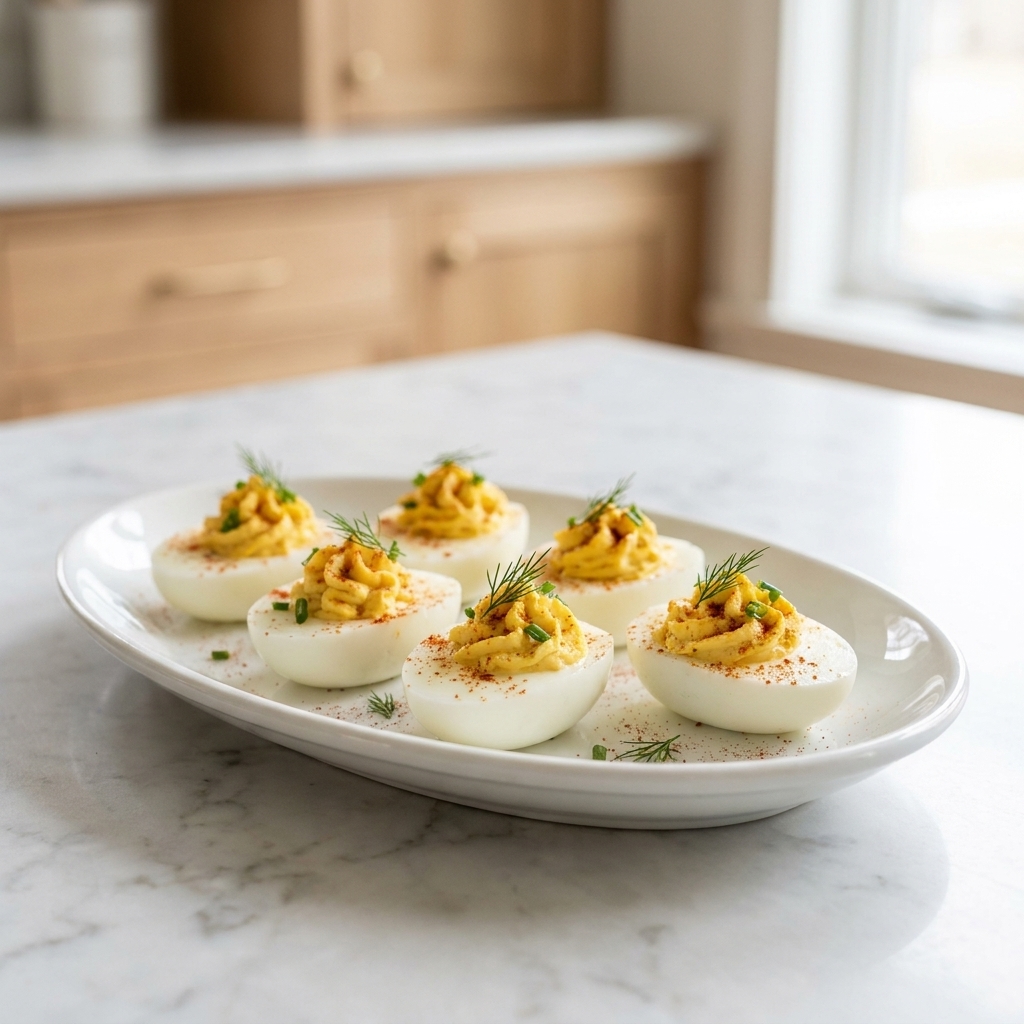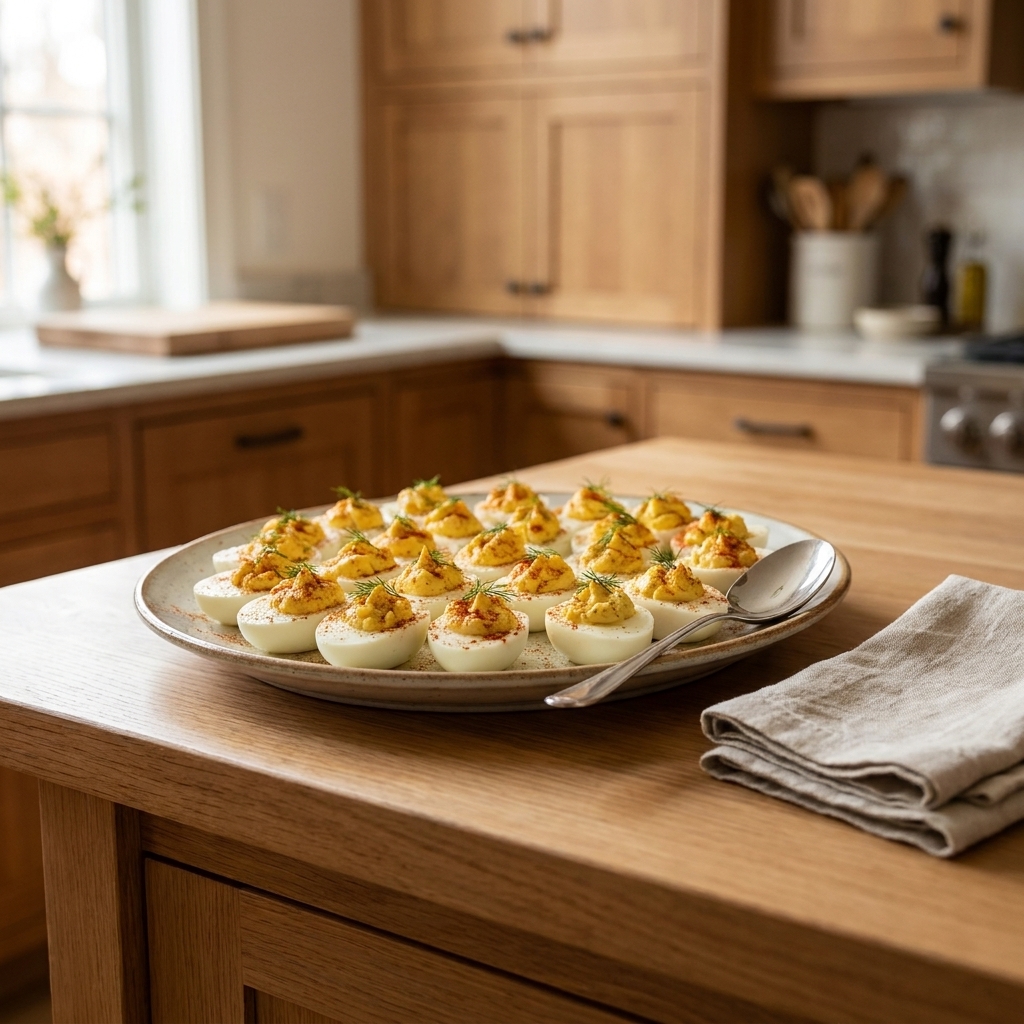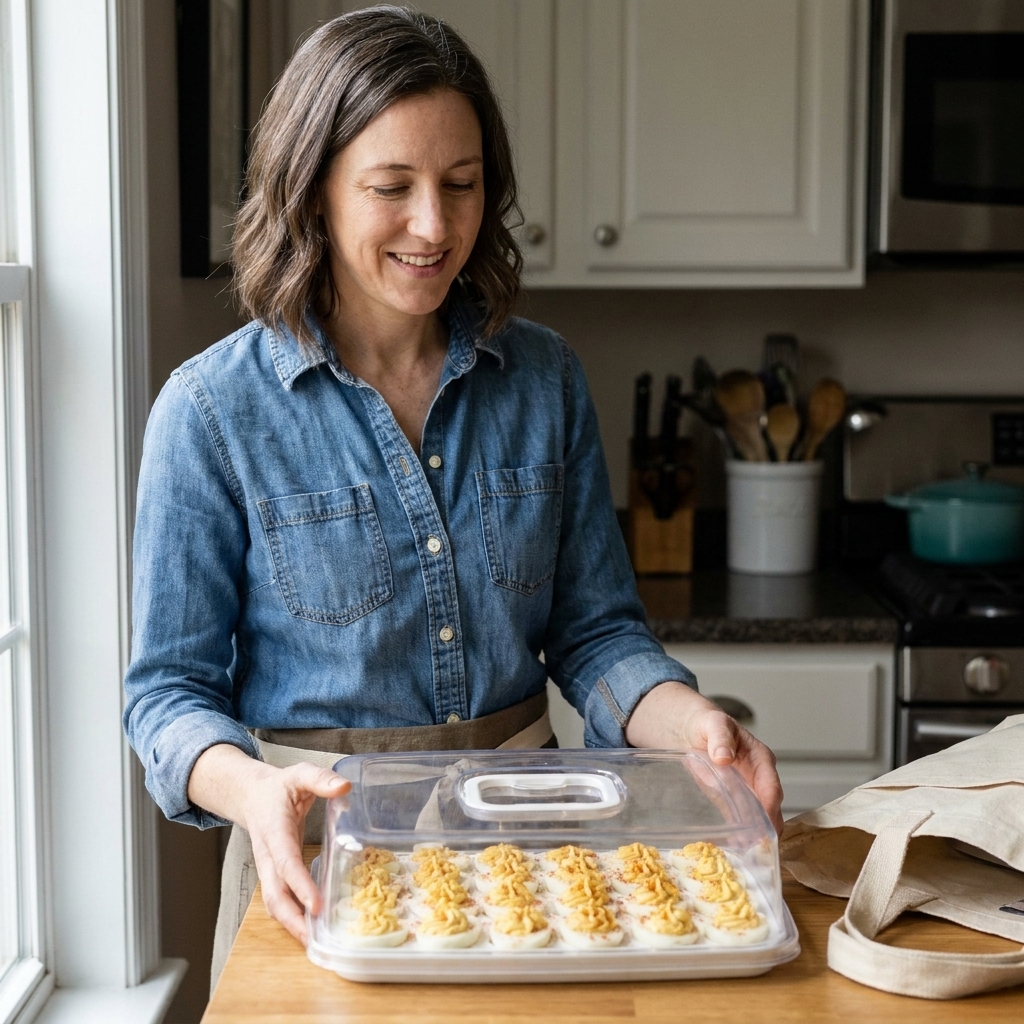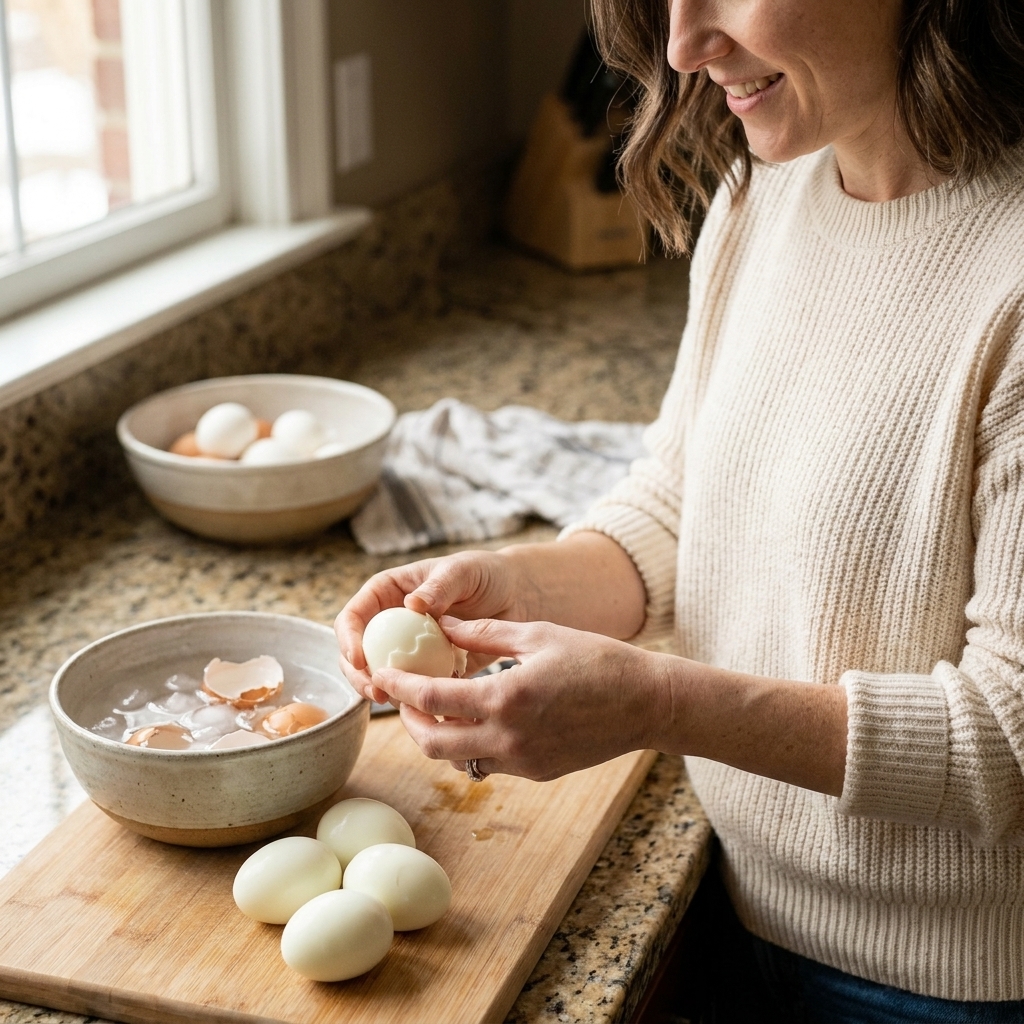

I grew up in a house where the appetizer spread was the main event. The kitchen island was basically a racetrack of little plates, and if you blinked, the deviled eggs were gone. Fast forward to me hosting neighborhood potlucks and big family reunions, and I have learned one simple truth: deviled eggs are not hard, but they are mathy once you cross the 50-guest line.
This is my no-stress scaling guide. We are going to talk counts (how many halves you actually need), a foolproof base ratio you can multiply without overthinking, and the logistics that keep your eggs cold, neat, and not mysteriously runny.

First, decide how many deviled eggs you really need
For big events, I plan in egg halves per person. It is the easiest mental shortcut, and it accounts for the fact that people take two, wander off, and then come back for two more.
- Light snack table (lots of other apps): 1 half per person
- Normal party spread: 2 halves per person (my default)
- Deviled eggs are a “main character” appetizer: 3 halves per person
Now convert halves to whole eggs:
- 1 egg = 2 halves
- Eggs needed = (guests x halves per person) ÷ 2
Quick counts for 50+ guests
| Guest count | 1 half each | 2 halves each | 3 halves each |
|---|---|---|---|
| 50 guests | 25 eggs | 50 eggs | 75 eggs |
| 60 guests | 30 eggs | 60 eggs | 90 eggs |
| 75 guests | 38 eggs | 75 eggs | 113 eggs |
| 100 guests | 50 eggs | 100 eggs | 150 eggs |
My hosting rule: add a buffer of 10 to 15 percent if you are feeding hearty eaters, teens, or anyone who has ever said “I could eat a dozen deviled eggs.” If you are right on the edge, round up to the next full dozen eggs. Extra halves disappear.
If you want help planning the rest of your spread (so the eggs are not doing all the heavy lifting), start with Party Food.
The base ratio that scales cleanly
Most deviled egg recipes are some version of mayo, mustard, salt, acid, and a little something for personality. When I scale up, I anchor everything to a single unit: 12 eggs (24 halves). It is easy to multiply, and it fits neatly into mixing bowls and storage containers.
Base filling ratio for 12 eggs
This is a classic, crowd-pleasing base that tastes “deviled” without being spicy unless you make it that way.
- 12 hard-boiled eggs
- 1/2 cup mayonnaise (8 tablespoons)
- 2 teaspoons yellow mustard (or Dijon for a sharper bite)
- 1 teaspoon acid (pickle juice, lemon juice, or vinegar)
- 1/2 teaspoon fine salt (plus more to taste)
- 1/8 teaspoon black pepper (or a few grinds)
Texture note: this ratio pipes well. If you prefer a looser, creamier filling, increase mayo by 1 to 2 tablespoons per 12 eggs. If you like it sturdier for a warm room or outdoor buffet, decrease mayo by 1 tablespoon per 12 eggs and lean on a thicker add-in like extra yolk or softened cream cheese.
Need a refresher on getting clean, non-gray yolks and easy-peel whites? I use the method in How to Boil and Peel Eggs for Deviled Eggs.
Scaling chart for 50, 60, 75, and 100 eggs
Below is the same base ratio scaled up. These amounts assume standard large eggs and a classic mayo-based filling.
Quick rounding note: big-batch deviled eggs still need human taste buds. The mayo numbers are exact enough to measure by the cup. For mustard, salt, and acid, I round to practical kitchen measures and suggest you start a touch under, then adjust to taste.
Tip before you shop: eggs are usually sold by the dozen, mayo jars vary, and mustard bottles are all over the map. I list both cups and spoon measures so you can buy confidently.
For 50 eggs (100 halves)
- Mayonnaise: 2 cups + 2 tablespoons (34 tablespoons)
- Mustard: 2 tablespoons + 2 teaspoons
- Acid (pickle juice, lemon, vinegar): about 4 teaspoons
- Fine salt: 2 teaspoons + a pinch, then taste
- Black pepper: about 1/2 teaspoon
For 60 eggs (120 halves)
- Mayonnaise: 2 1/2 cups (40 tablespoons)
- Mustard: 3 tablespoons + 1 teaspoon
- Acid: 5 teaspoons
- Fine salt: 2 1/2 teaspoons
- Black pepper: about 5/8 teaspoon
For 75 eggs (150 halves)
- Mayonnaise: 3 cups + 2 tablespoons (50 tablespoons)
- Mustard: 4 tablespoons + 1/2 teaspoon
- Acid: 6 teaspoons + 1/4 teaspoon
- Fine salt: just over 3 teaspoons (1 tablespoon plus a pinch)
- Black pepper: about 3/4 teaspoon
For 100 eggs (200 halves)
- Mayonnaise: 4 cups + 2 tablespoons (66 tablespoons)
- Mustard: 5 tablespoons + 1 1/2 teaspoons
- Acid: 8 teaspoons + a pinch (start here, then taste)
- Fine salt: 4 teaspoons + a pinch (1 tablespoon plus 1 teaspoon)
- Black pepper: about 1 teaspoon
My accuracy secret: once you scale past 50 eggs, measure mayo by the cup, but measure mustard, salt, and acid slowly and taste as you go. Your pickles, mustard strength, and even egg size will nudge the balance.
How to scale add-ins without breaking the filling
This is where big-batch deviled eggs can go sideways. We get excited, dump in “just a bit more relish,” and suddenly the filling is wet and sloppy. Here is how I scale common mix-ins for every 12 eggs, with crowd-safe ranges.
Crunch and brine
- Sweet pickle relish: 1 to 2 tablespoons per 12 eggs (drain if it looks juicy)
- Finely minced dill pickles: 2 to 3 tablespoons per 12 eggs (pat dry)
- Chopped olives: 2 tablespoons per 12 eggs (drain well)
If you want a bigger pickle flavor, increase pickle juice before you increase chopped pickles. Juice boosts flavor without making the filling lumpy.
Heat
- Hot sauce: start with 1 teaspoon per 12 eggs, then taste
- Cayenne: start with 1/8 teaspoon per 12 eggs
In a huge batch, spice compounds fast. Mix, taste, wait 2 minutes, taste again.
Richer additions
- Cream cheese: 2 to 4 tablespoons per 12 eggs (softened)
- Sour cream or Greek yogurt: swap for up to 1/4 of the mayo
These are your best friends when you need structure for a long buffet.
No-mayo scaling note
If you are making deviled eggs without mayo, the ratios change because yogurt and avocado behave differently than mayonnaise. I keep a separate approach in No Mayo Deviled Eggs.
Big-batch workflow
When you are making deviled eggs for 50+ guests, the cooking is not the hard part. It is the storage, chilling, and assembly. Here is the workflow I use when I do not want to be piping eggs in a party dress.
My preferred timeline
- 2 days ahead: shop, clear fridge space, make sure you have enough trays and containers
- 1 day ahead: boil and peel eggs, store whites and yolks separately
- Day of: mix filling, pipe, garnish, tray up, keep cold until serving
For a deeper make-ahead breakdown (and what is safe), see How Far in Advance Can You Make Deviled Eggs.
Separate storage is the secret
If you only take one tip from me, take this: do not fill the whites until you are close to serving. Store:
- Egg whites: in an airtight container, lined with a paper towel to absorb moisture
- Yolk filling: in a piping bag set inside a cup, or a zip-top bag with the corner snipped later
This keeps the whites from getting slick and the filling from crusting over.
Fridge space
Rough estimate: a standard deviled egg tray holds 24 halves (12 eggs). For 100 halves, you are looking at four to five trays depending on tray style and garnish height. Before you commit, do a quick tray count at home. If fridge space is tight, store whites in containers and pipe onto platters later.

Transporting to weddings and reunions
- Transport filled eggs cold: nested trays or sheet pans covered tightly
- Use a cooler: flat ice packs under and around, not loose ice that can melt onto eggs
- Bring a backup piping bag: because the corner will split at the worst possible moment
Once you arrive, keep the platter chilled and refresh it in smaller batches instead of putting every egg out at once.
If you are building a full chilled spread, I map it out the way I do in Plan a Chilled Deviled Egg Party Tray.
Fix runny filling and bland flavor
If your filling is runny
Big batches are more likely to get loose because mix-ins vary and people tend to over-mayo “to be safe.” If it happens, you can rescue it.
- Chill first: 30 minutes in the fridge firms up mayo-based fillings
- Add structure: a spoonful of mashed yolk (yes, more yolk), cream cheese, or a tiny amount of instant mashed potato flakes
- Drain wet add-ins: relish and pickles should be patted dry
I go step by step in How to Fix Runny Deviled Egg Filling.
If your filling tastes flat
This is almost always one of three things: not enough salt, not enough acid, or not enough mustard. When I season a big batch, I adjust in this order:
- Salt: add 1/4 teaspoon at a time, mix, taste
- Acid: add 1/2 teaspoon at a time, mix, taste
- Mustard: add 1 teaspoon at a time, mix, taste
Once it tastes lively, then you can play with paprika, dill, chives, or bacon.
Garnish math
Garnishes feel optional until you are staring at 120 identical egg halves and thinking, “These look... naked.” Here are my shopping shortcuts:
- Paprika: 1 small jar is plenty for 100 eggs
- Chives: 1 large bunch comfortably garnishes 100 halves (more if you go heavy)
- Bacon: 1 slice can top 6 to 8 halves when crumbled fine
- Pickled jalapeños: 1 jar is plenty for 100 halves if you use small pieces
If you want flavor ideas that scale beautifully (and feel a little fancy without being fussy), I keep favorites in 10 Gourmet Deviled Egg Variations for Cocktail Parties.
My crowd checklist
- Pick your serving rate (1, 2, or 3 halves per person), then add a 10 to 15 percent buffer
- Scale from a 12-egg base ratio so your math stays clean
- Measure mayo by cups, but season slowly and taste often
- Store whites and filling separately, then pipe close to serving
- Keep everything cold during transport and on the table
If you want the broader basics (tools, toppings, timing), the hub I point friends to is Guide to Deviled Eggs.